
Declining Leads: Is It the Market or Are You Losing Share?

Leads are down. Ask two questions, not one.
Three months of decline… and someone wants an answer by Friday.
Leads have been sliding for a few months. Not a cliff, just a steady drift downward that you couldn’t quite dismiss after the second month and definitely can’t dismiss now. Your team has already looked into it and come back with one of two explanations, and to be fair they are both reasonable. The market is soft or a competitor is getting aggressive. Either way there’s a recommendation attached, and it involves either spending more or spending less.
The immediate pressure you’re under right now isn’t really the pressure to be right. It’s pressure to be seen doing something about it. Those are different things, and confusing them is how a soft quarter turns into a bad year.
This is one of the few situations in marketing where moving slowly is the correct call. Most problems reward fast iteration, but this one may punish it, because the two most likely explanations call for opposite responses. Picking wrong doesn’t just cost you a wasted month. It accelerates the decline. Spend hard into a market that genuinely contracted and you might be paying twice as much for the same customer, or worse, a customer who isn’t there. Pull back while a competitor is quietly taking your market share and you’ve handed them the rest of it.
So it’s worth slowing down long enough to ask better questions before anyone commits to a direction.
You need to be asking two questions.
“Is it the market or the competition?” sounds like one question. It isn’t, and asking it that way turns your next meeting into a debate between two camps who each showed up with evidence.
Break it in half:
Is the demand still there? AND… Are you still getting your share of it?
Those are independent of each other. The category can be growing while your share of it collapses. The market can be shrinking while your share holds perfectly steady. Both can move at the same time, in the same direction or in opposite ones. Every one of those combinations means something different about what you should do.
Answer them one at a time and most of the argument dissolves on its own, because you’ve stopped debating a conclusion and started establishing two separate facts.
Notice which answer the room is reaching for.
Before you look at any data, it helps to understand why people are leaning the way they’re leaning.
Market weakness is a comfortable explanation. It’s faceless, it has no name, and it isn’t anyone’s fault. Nobody gets put on a performance review because interest rates moved. An aggressive competitor is a different situation. A competitor has a name, which somehow makes them feel more threatening and more solvable at the same time.
Which of those feels safer depends on where you sit.
If you run the marketing, the market culprit is the kinder explanation, because missing a competitor looks like something you should have caught. If you own or are responsible for the company, it flips completely. A competitor is frightening but beatable, while a category that’s genuinely drying up raises a much bigger question about the business you’ve spent years building.
So the explanation you get handed tends to correlate with who’s handing it to you. Nobody in that room is being dishonest about it either. They’re reaching, mostly without noticing, for the answer that costs them least if it turns out to be true especially when the evidence is murky and can support both conclusions at the same time.
The most useful thing you can do is ask “what indicators would change our minds?” If nobody can answer that, you don’t have a diagnosis yet. You’d be left with a conclusion that went looking for support.
Axis one: Is the demand still there?
This one asks whether buyers for what you sell still exist in the numbers they used to, regardless of whether any of them are reaching you. You should be looking at the category, not at yourself.
A common part that people skip is figuring out what kind of decline they’re looking at. A soft quarter, a seasonal dip and a structural multi-year contraction may all look similar in a twelve-month view, and they call for completely different plans. A dip you ride out. A shift caused by something durable, like a change in rates or regulation or how buyers in your category now prefer to buy, you need to be built to survive rather than just out-hustle. Look back far enough to see whether this has happened before at this time of year, and whether it started when something specific changed.
You may additionally be faced with a tricky judgment call where category interest and purchase intent are not the same thing. People can still be looking while their budgets, their urgency, or the way they prefer to buy have changed. Treat what you find as directional rather than definitive, and don’t let a clean-looking line chart talk you out of checking the second axis.
Axis two: Are you still getting your share of it?
This is the harder one, and it’s harder for a structural reason. Market share isn’t something you can observe directly. Nobody can just report it to you. Rather, you have to infer it, and from a few different angles that have to agree with each other before you trust the answer.
You’re looking for divergence. If category demand is holding and your volume is falling, something is absorbing the difference. Look at whether any specific competitor is gaining visibility and attention rather than just drifting around like everyone else does month to month. Consider the places buyers go before they ever type your category into a search box, because that may be where a lot of this gets decided.
What happens before the search occurs is the blind spot that catches capable teams. Your reporting can only see people who reached you. It has nothing to say about the buyer who read a comparison article, formed an opinion, and went straight to a competitor by name. From inside your own numbers, a buyer who chose somebody else and a buyer who never existed look exactly the same. Both just show up as an absence.
This is a case you build rather than a number you read. One competitor gaining ground consistently over many months means something. General noise usually doesn’t.
The four situations you could be in.
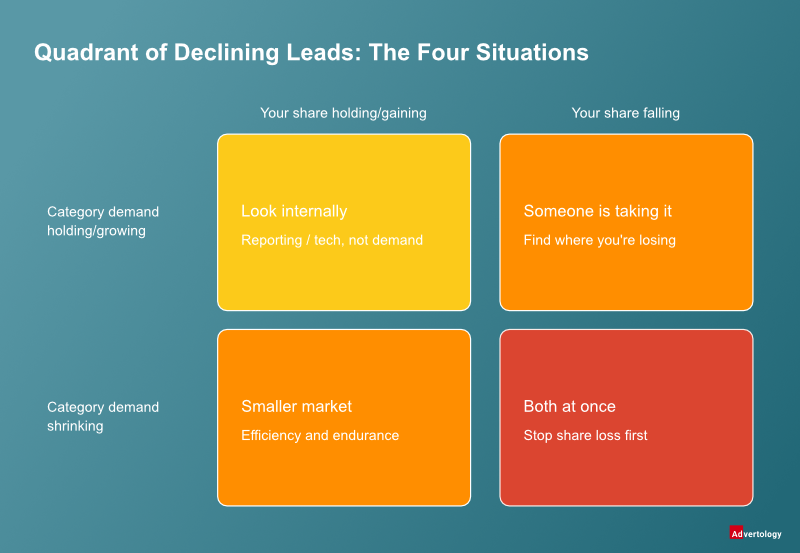
Demand holding, share holding. The buyers are there and you’re still getting your usual portion of them, which means the problem is downstream of everything we’ve discussed. Traffic arrived and something stopped converting. Look at what changed on your side: the offer, the experience, who’s answering the phone and how fast. More likely any sudden and prolonged volume deviations here are internally caused.
Demand holding, share falling. Someone is taking market share from you. Before you decide how much more to spend, find out where you’re actually being beaten, because losing on visibility, losing on your offer, and losing on the product itself are three different problems with three different budgets. Spending more to fix a weak offer just shows the weak offer to more people.
Demand shrinking, share holding. You’re doing fine in a smaller room. This calls for efficiency and endurance rather than aggression, and how long the contraction lasts determines almost everything else. And something worth remembering, when competitors panic and retreat, the remaining demand sometimes gets cheaper, not more expensive.
Demand shrinking, share falling. Both at once is the toughest version. Addressing only half of the problem quietly fails. Instead, address it in sequence. Stop the share loss first, because the market contraction will still be waiting for you after you deal with the competition and usually the market moves a lot slower.
Holding and gaining read the same way here. If your share is growing and leads are still down, the answer is in the same cell.
What to do when the answer isn’t clean.
It still may not be an easy answer and evidence may disagree with each other. Both may be weak enough that you wouldn’t defend either one in a board meeting.
When the signals disagree, that means you should keep looking. It does not mean pick the one you like better, though that’s exactly what tends to happen when there’s a deadline attached.
Acknowledge how sure you are about your conclusions. There is a big difference between “it’s the market” and “I think it’s the market, and I’m maybe 70% confident about it, and if the category numbers drop next month I’ll change my mind.” While the second version sounds weaker, it’s far more useful because everyone knows you’re watching it and will revisit in the near future. The first version may just end the conversation prematurely.
Don’t force yourself into a cell. Being 70% sure about the right question puts you in far better shape than being certain about the wrong one.
Two questions, in that order.
Demand first, then market share. Establish whether the buyers still exist before you argue about who’s getting them.
It’s worth the extra two weeks because the two most likely wrong answers here don’t fail gently and they’re not usually in the same direction. One has you spending into empty air. The other has you retreating from a fight you could still win. Almost any deliberate answer beats a fast one.
Where to get started this week.
You don’t need a perfect measurement to make progress. Get two things in front of you before the next meeting: something showing category interest over the last eighteen months, and your own volume over the same window. Then look at whether the two lines move together or apart. That comparison alone will usually tell you which half of the grid you’re in, and it’s an afternoon of work rather than a project.
Consider putting a date on it. Whatever you conclude this week, decide now when you’ll look again. Remember to specifically ask yourself what would make you change your mind. That one habit is the difference between a diagnosis and a permanent assumption.
