
“Scale It” Is Not a Strategy

When something works and someone says scale it.
You’ve probably been in this situation. Something works, maybe a good month or a campaign that’s clearly performing, and what typically happens next is that someone says “scale it.”
“Scale it” assumes the next dollar works as hard as the last one.
It feels like an obvious moment. If spending $50,000 produced this result, then spending $100,000 should produce about twice as much.
The person running the marketing usually knows that doubling the budget doesn’t double the results. What they often do is say yes anyway, because the honest answer is “it depends,” and nobody wants to hear that. It can sound like they don’t want to grow the one thing that’s finally working.
So the instruction goes through, carrying an assumption nobody said out loud: that the next dollar is going to work as hard as the last one. Sometimes it does. Often it doesn’t, and a scaling decision isn’t responsible until someone has asked how hard that next dollar will actually work. “Scale it” assumes the next dollar works as hard as the last one.
Why the next dollar usually buys less.
The demand that exists in your market right now is finite. You can sometimes grow it, but that’s a different project with a different budget. Scaling a campaign means competing harder for the audience that is already out there.
Your first ad dollars reach the people most ready to buy. The later dollars reach people who are less ready, less qualified, or just browsing.
It helps to picture roughly how the platforms spend a budget. With a small one, the platform looks for whoever is most likely to act at any given moment. On a search platform that’s someone searching for exactly what you sell. On other platforms it’s whoever the system judges most qualified to see your ad right then. As you spend more, it moves on to the next most likely person, and the next, working its way down the list. New qualified people keep showing up over time, of course, but the more you’re spending in any given moment, the further down that list you go.
Spending more also means paying more for the same attention. You’re paying for higher positions and broader reach, and competing harder in the same auctions for people who were already there.
Why the average hides it.
When you look at cost per lead or cost per acquisition, you’re usually looking at a blended rate. It averages across everyone the budget reached, from the people ready to buy to the ones who were only looking. Blended together, the number can look fine. Some of those customers cost you quite a bit more, and you just don’t see it.
The average lets the dollars that work quietly pay for the ones that don’t.
Here’s a composite with rough numbers. Say you’re spending $50,000 a month and getting about 250 leads, which works out to $200 per lead.
You double the budget to $100,000 and get 375 leads. The blended cost is now about $267 per lead. It went up, but not drastically, and it looks tolerable.
Now look at the second $50,000 on its own. The first $50,000 bought 250 leads. The second bought 125, which is $400 per lead, twice the original cost.
Does the difference actually matter?
It’s a fair question, and it’s one I asked myself. The blended rate is a true average. You spent $100,000, you got 375 leads, and $267 is what they cost. Why look at it any other way?
Because the decision you’re actually making is about the second $50,000, and whether that was worth it can have a different answer from whether the whole $100,000 was.
Say a lead is worth about $300 to you, once you account for how many close and what a customer brings in. At $50,000 a month, 250 leads are worth $75,000, so you’re $25,000 ahead. At $100,000 a month, 375 leads are worth $112,500, so you’re $12,500 ahead.
The blended cost of $267 is still under $300, so the program looks profitable, and it is. But doubling the budget cut what you made from it in half. The extra $50,000 bought $37,500 worth of leads, and the only reason that doesn’t show up as a loss is that the first $50,000 is covering for it. The average lets the dollars that work quietly pay for the ones that don’t.
None of this makes $400 a bad price. If a lead is worth $600 to you, the second $50,000 was a good buy and you might want a third. It really depends on what a customer is worth. You just can’t tell from the blended rate, and the blended rate is what usually gets reported.
Sometimes scaling really is cheap.
I want to be clear that you can also see the opposite effect, and it’s worth knowing when it happens.
A profitable campaign that’s being held back by its budget can often take more money at a similar cost. It was hitting its budget limit while there were still good prospects to reach, and the extra money lets it reach them.
A low-volume account can get more efficient as it grows. Many of the bidding and targeting systems platforms use now learn from your conversions, and they need a certain amount of data before they make much of a difference. I’ve had Google reps tell me they want something like thirty conversions before the bidding really starts to improve, and depending on how the campaigns are set up and what a conversion costs, some accounts struggle to reach that in a month or six weeks. Add budget and you give the system more to learn from, so it gets better at choosing who to bid on and how much. In that case the second $50,000 might buy leads more cheaply than the first.
The way I picture it is an arc. If you spend very little, you’ll probably pay a lot per lead, because the ad platform doesn’t have much data and you’re mostly hoping your initial targeting, copy and offer are good enough. As you add money, cost per lead comes down and you get more for each dollar. Then, because demand is finite, you reach a point where the learning is baked in and the extra money is mostly reaching less relevant people. The platform keeps broadening who it shows the ad to, because it’s trying to spend what you gave it. Cost per lead flattens out, then starts climbing again.
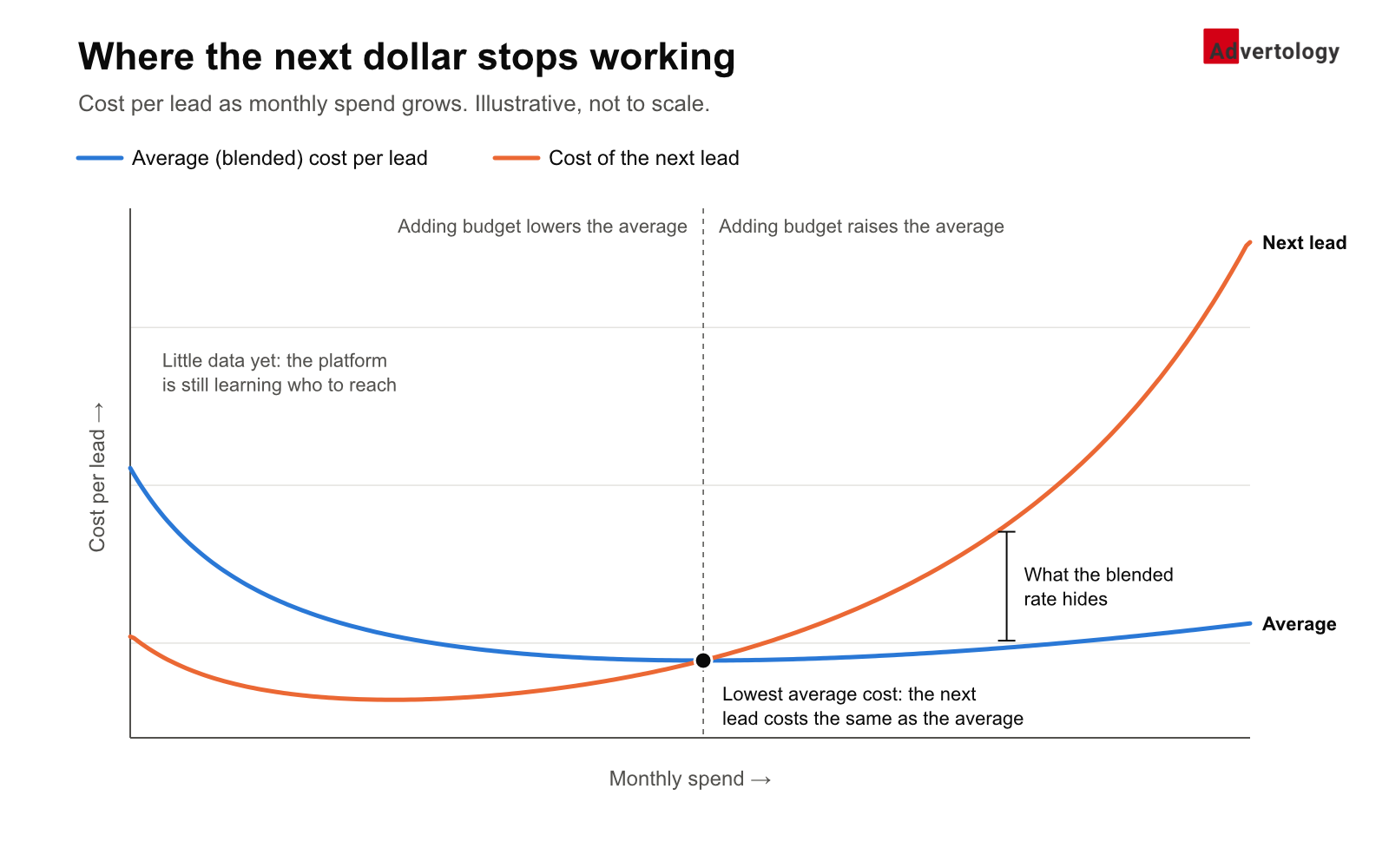
Real accounts are messier than that, because competitors, seasonality and plenty of other things push on the curve. But it’s a useful way to ask where you are on it right now, because that decides what the next dollar will do.
Your own history can show you where you are.
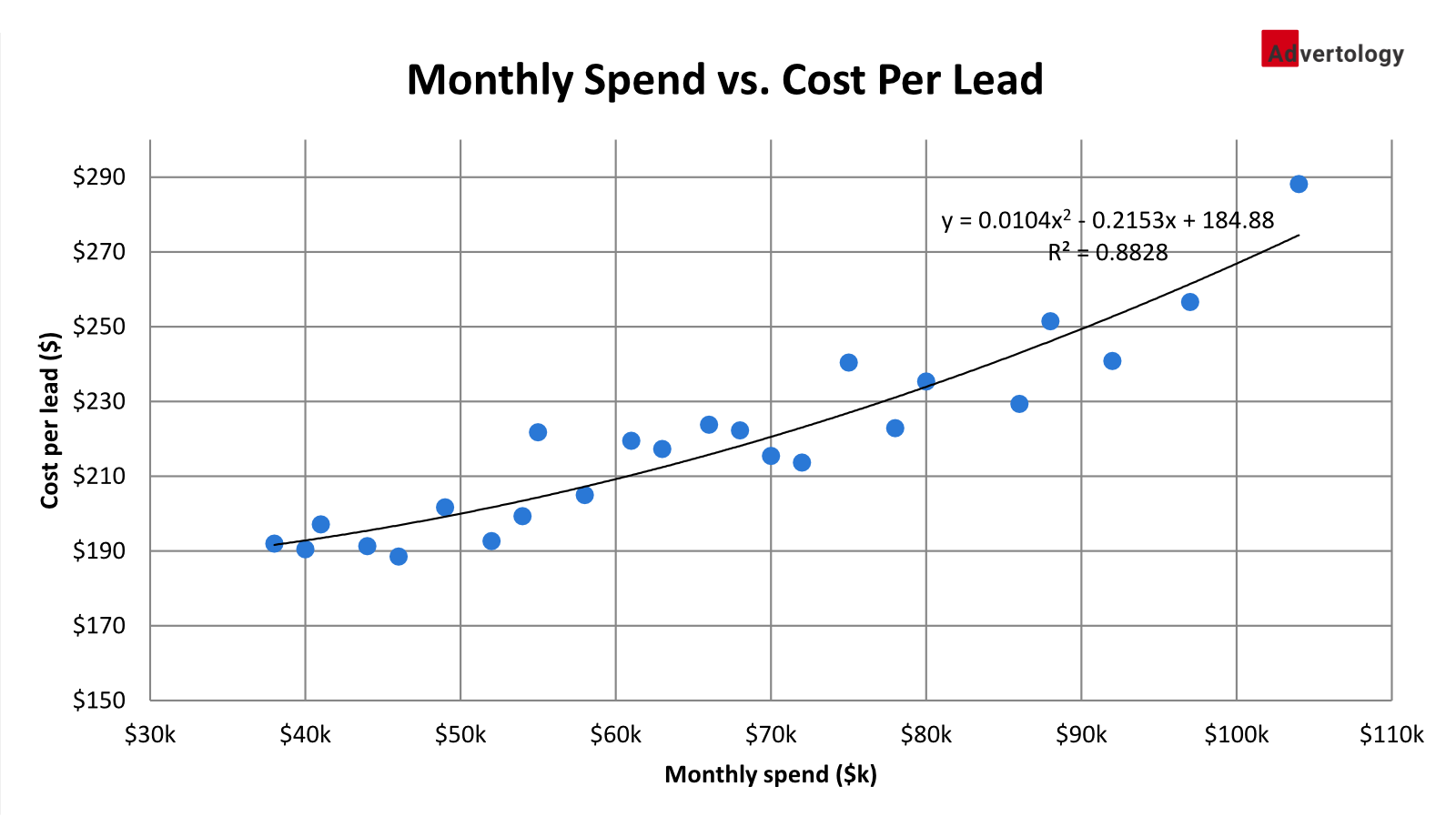
You probably have the data already. Try looking at every month over the last 12 to 24 months, showing what you spent and what each lead or customer cost, plotted against each other. If spend has been steady, you’ll mostly see movement from competition and seasons. If it’s gone up and down, whether because you grew over the year or spent more in some quarters than others, you can start to see how cost changes as spend changes.
Be careful with seasonality, though. If you always spend the most in your busy season, those months had more demand as well as more money, and the chart will make scaling look cheaper than it is. Someone comfortable with Excel can fit a curve through the points and estimate where cost starts to rise, but even the rough picture tells you whether you’ve ever actually been past the point where it bends.
Sometimes growth is worth paying more for.
There’s another fair objection. Sometimes growth matters more than efficiency, and paying more for the next customer is the right call.
A competitor might be pulling back, which makes the customers you win now ones they won’t get later. You might have cash to put to work and a board that wants to see the top line move. If your customers are worth far more than they cost, even an expensive one can be a good buy. And early in a market, there’s real value in getting established before the auction fills up.
All of that can be true, and every one of those cases is easier to act on when you know what the extra customers cost. Deciding to pay $500 a lead because you want the market share is a choice leadership can stand behind and revisit later. Paying $500 without knowing it, because the blended rate said $267, means nobody actually made that choice.
Scaling at a higher cost can be exactly the right decision. What makes it risky is doing it without knowing what you’re paying for the extra volume, or without anyone having decided the price is worth it.
What to settle before you scale.
A few things should be settled before anyone decides whether to scale, and by how much.
What will the next customer cost, compared with the average one? That’s the second $50,000 on its own. Leave the blended rate aside, work out what the extra money buys by itself, and ask whether that price is tolerable.
Where does it stop being worth it, and who decides? That’s a leadership number, probably settled with the CFO in the room. It shouldn’t be left to the marketer to guess. You always want to know how much you’re willing to spend to acquire a customer. If you don’t know that already, it’s worth the time to talk with the people who’d know and work it out, at least directionally.
How long before you know whether it worked? When a budget goes up, the platforms’ bidding systems usually go through a period of adjusting, typically a week or two, where results are noisy and often worse before they settle. Leads also take time to close. If your sales cycle runs sixty days, the leads from the extra spend won’t have had a chance to become customers for two months. Judge it after three weeks and the new spend will look worse than it is, because its leads are simply younger. Agree up front on when you’ll look, far enough out to cover the adjustment period and the sales cycle.
What result would make you stop? Decide this before the money goes out the door. Something like: if the extra spend is still costing more than $300 a lead when we review it in ninety days, we go back to the previous budget. With that agreed, if it doesn’t work out, you already know when you call it and how. It protects the decision in the other direction too, because a rough first month isn’t a reason to pull back when everyone has already agreed it’s too early to tell.
“Can we scale it?” is a question about price.
So back to the original question. When someone asks whether you can scale it, whether you’re the marketer hearing it or the owner or CFO asking, treat it as a question about price and range rather than a yes or no.
A useful answer sounds something like this: “Yes. Up to about $70,000 a month, we’d expect the extra leads to cost around $300. Past that, it’s more like $500 and climbing. What’s a lead worth to us?”
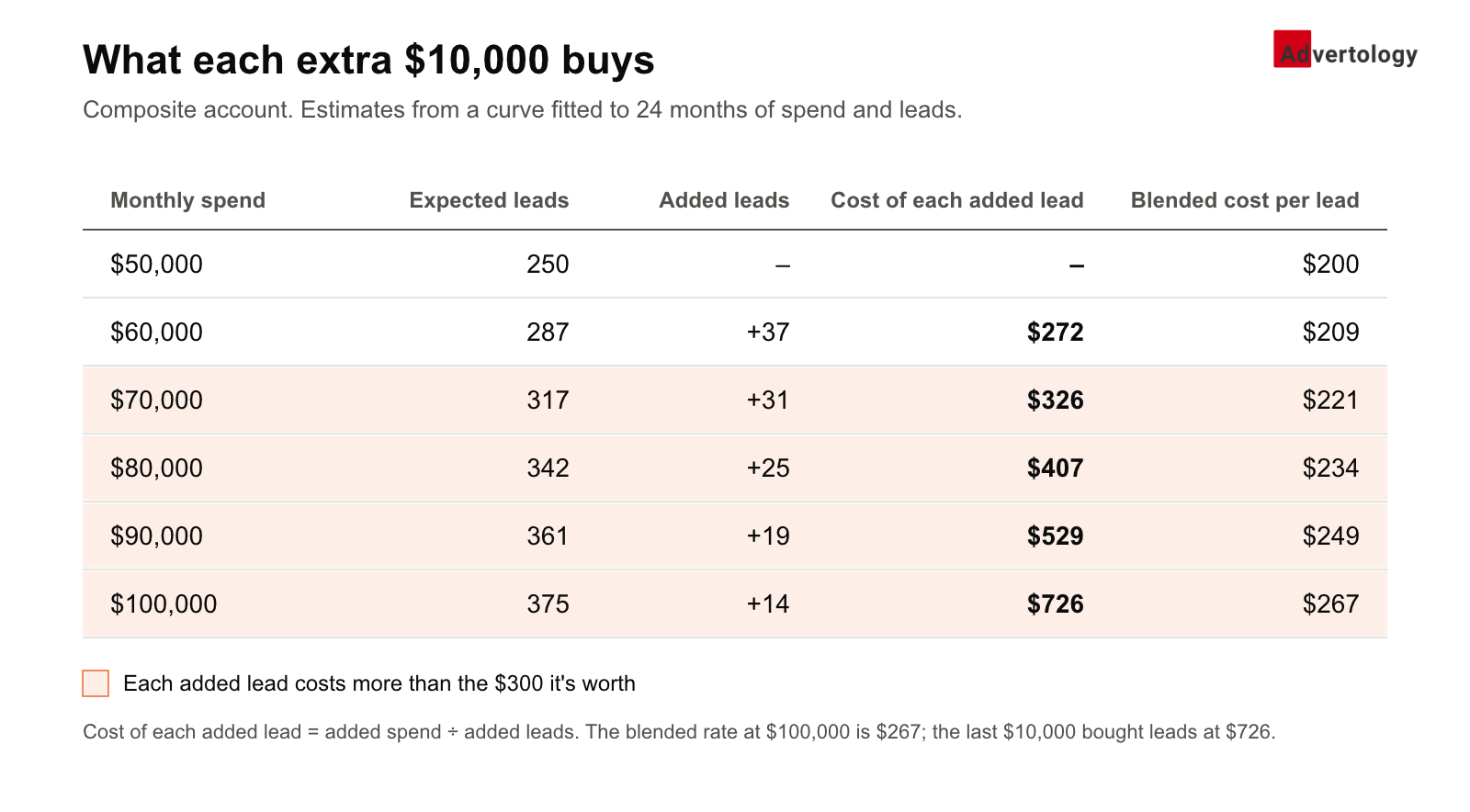
That gives leadership what they actually need to decide, which is what the growth will cost. The range is honest about the uncertainty, and the question at the end puts the decision with the people who should make it. If the answer is $300, as in the earlier example, you’ve also found where to stop: somewhere between $60,000 and $70,000. And it turns “it depends” into something a room can act on, instead of something that sounds like reluctance.
Before the next time someone says scale it.
Try to anticipate the questions that come up when a campaign works and there’s a push to put more money behind it. Then when it happens, you can say, “Here’s how much we’re willing to pay per customer. Let’s increase the budget, and we’ll judge it by what we’re actually paying for the additional spend, not the blended rate.” That might change how you feel about scaling. It’s a judgment call, and it should be, but it’s only a good one once you know how much you can spend to acquire a customer.
If you want somewhere to start this week, find the last time your budget went up and work out what the extra money bought on its own.
