
Too few sales to optimize to? Use a proxy that tracks them.

When there are too few sales to learn from.
Optimizing an ad account, whether automated bidding does it or a person does it by hand, comes down to comparison: which keywords, ads and audiences produce sales, and which don’t. That comparison needs volume. When a business closes only a handful of sales a month, or when individual campaigns each produce only a few, there isn’t enough to compare, and optimizing directly to sales stops working.
The hopeful fix is to optimize to a more frequent event that stands in for the sale, such as a qualified lead or a booked appointment. That event is called a proxy. A good proxy happens often enough to learn from and has been checked against actual sales. A poor one can steer budget toward the wrong people for months while the reported numbers improve.
Why a few sales can’t teach anyone.
With only a few sales, chance variation is larger than most real differences. If a campaign produces three sales one month and six the next, that could be a genuine improvement, or it could be three more buyers happening to decide in the same month. The numbers alone can’t separate the two.
Splitting the sales up makes it worse. Ten sales spread across a dozen keywords, several ads and a few audiences leaves most of them with zero or one, and there’s nothing to compare.
This limits people as much as algorithms, so switching to manual bidding doesn’t solve it. Automated bidding will still run at low volume. It just has very little to learn from the sale itself.
A useful floor is about 30 of whatever you’re judging within your decision window. The decision window is the period of time you’d look at before deciding whether something is working and changing course, which for most businesses matches how often performance gets reviewed, monthly or quarterly. It has to be long enough to collect about 30 events, including enough time for them to happen after the clicks that led to them, and short enough that you can still act on what you find.
Thirty is a convention rather than a law, but it’s roughly where ordinary fluctuation stops drowning out real differences. It also applies to each thing being judged rather than the account as a whole, so comparing two campaigns takes about 30 each.
Optimizing and watching a conversion event are different jobs.
Before choosing a proxy, find out what the account or campaign optimizes to now. It may be sales, form fills, calls, a default set up with the account and never revisited, or nothing in particular, in which case the bidding is chasing clicks.
Optimizing to a conversion event means the bidding chases it, and you usually pick one event or a small set of them to focus on. Watching an event means you track and report on it, and you can watch as many as you like without changing what the bidding does.
That separation is what makes a proxy safe to use. You can optimize to a proxy while watching sales, and watching sales is how you find out whether the proxy is working. You can also watch a candidate proxy for a few months before letting the bidding chase it, which costs nothing.
Why form fills and free trials usually make weak proxies.
The most common proxy is a contact form or a free trial sign-up, largely because it’s easy to count and there are plenty of them. It’s usually a weak one.
A form fill costs the person filling it almost nothing. Some come from real buyers, but many come from students, job seekers, people with no plan to buy this year, competitors, vendors who want to pitch you, and bots. A free trial asks for an email address, and many people who sign up never return. The volume looks healthy while the link to sales stays loose.
Optimizing to form fills tells the platform to find more people who fill in forms, and it will find the ones it can reach at the lowest cost. Bidding tends to find the cheapest version of whatever it’s told to chase. If those people were never going to buy, cost per lead improves while sales stay flat.
A useful proxy usually includes a qualifying step that separates likely buyers from people passing through. Three kinds work well:
- A salesperson made contact and confirmed the lead is real and relevant.
- The person gave up some time, such as attending a webinar or completing a consultation. Registering for a webinar costs nothing, but attending one costs an hour.
- The lead matches criteria you already know matter, such as a location you serve, a company size or a budget range.
Bidding tends to find the cheapest version of whatever it’s told to chase.
Further down the funnel, events are fewer and usually better.
An enrollment office moves from inquiries to applications to deposits. A specialty clinic moves from calls to booked consultations to patients starting treatment. A professional services firm moves from form fills to meetings to proposals to signed work.
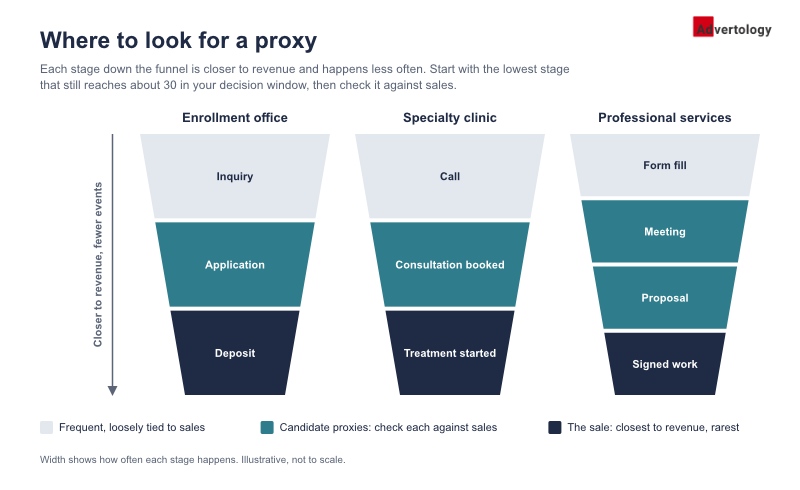
Each stage is closer to revenue than the one above it and has fewer people in it. Closer to the sale often means a better predictor of the sale, and that’s the place to start looking, but it isn’t guaranteed. If proposals go to anyone who asks for one, a proposal count may say more about the sales team’s habits than about who will buy.
Higher stages give you plenty of events and a weaker link to sales. Lower stages usually give a stronger link and less to learn from. A reasonable starting point is the lowest stage that still reaches about 30 in your decision window, checked against sales before you rely on it.
How to check whether a proxy tracks sales.
A proxy has three tests to pass. It has to happen often enough, meaning about 30 in your decision window. It has to happen soon enough after the click to be useful, since part of its value is arriving sooner than the sale. And it has to track sales, which is the test that matters most and is skipped most often.
The proxy-to-sale rate
The clearest way to test whether a proxy tracks sales is a rate: of the proxies from a given month, what share became sales?
Take an example with invented numbers. An account produced 40 qualified leads in March, and its sales typically close within 60 days of a lead qualifying. By the end of May, most March leads that were going to buy have bought. If 5 of the 40 became customers, March’s rate is 5 in 40, or 1 in 8.
Repeat that for each of the last twelve months and plot the rates on a line chart. If the line holds near 1 in 8, the proxy tracks sales, and more proxies should bring more sales at a predictable ratio. That’s what you need to know before letting the bidding chase it. If the line swings between 1 in 3 and 1 in 30, or drifts steadily down, the proxy doesn’t track sales, however sensible it looks.
Run the same check on form fills for comparison. A form-to-sale rate of 1 in 60 that swings widely, next to a qualified-lead rate that holds steady, makes the choice straightforward.
Follow each month’s leads, not each month’s totals
The most common error is comparing a month’s proxies with the same month’s sales. Many of those sales came from earlier leads, so the comparison mixes two different groups of people. The rate only works when it follows the same leads through to the sale. For the same reason, leave the most recent months off the chart until their sales have had time to arrive.
If the CRM can’t link a sale to the lead it came from, compare monthly totals offset by the lag, so March’s proxies against May’s sales. That’s a weaker check and should be presented as one.
The rate has the same small-number problem as everything else. With about five sales behind each month, a month at 1 in 6 followed by one at 1 in 12 may mean nothing. Grouping months into quarters smooths this out.
A caution about correlation coefficients
An analyst may offer a correlation coefficient instead, a single number between -1 and 1 describing how closely two things move together. Its advantage is simplicity. With only twelve monthly points, though, one unusual month can move it a long way, and if proxies and sales both rise every spring for seasonal reasons, it can look strong even when the proxy says nothing about which leads will buy. The rate is harder to mislead and easier to explain to finance.
The obvious proxy isn’t always the right one.
I’ve seen proxies that made complete sense on paper fail to track sales, back before there was data further down the funnel to check them against. When we broke one of those proxies into segments, one segment, people who watched an explainer video and came back to the site within two days, tracked sales far more closely than the proxy as a whole.
A proxy is only as good as the last time someone checked it against sales.
Segmenting is worth trying when a proxy disappoints, with two cautions. Slice a small dataset enough ways and one slice will look strong by chance, so confirm a promising segment on later months before committing to it. And a segment shows who is buying now, which isn’t necessarily who you want more of. It may reflect the people your current ads already reach, or a group that closes easily and spends little, so check what those customers are worth as well as how reliably they convert.
A proxy can also stop working after it’s chosen. Once the bidding chases it, the platform may find people who reach the proxy without becoming buyers, and market or competitor changes can weaken a relationship that held last year. A proxy is only as good as the last time someone checked it against sales, so the rate belongs on the regular report for as long as the proxy is in use.
When no proxy passes the tests.
Sometimes every stage fails. The frequent ones don’t track sales, and the ones that track sales are too rare. The answer then is to build a better proxy.
One way is to bring a salesperson in earlier. A short call to confirm a lead turns a form fill into a qualified lead within a day or two, keeping the proxy fast while making it far more meaningful. It costs sales time, so it suits businesses where each sale is worth a lot.
Another is to make the funnel harder on purpose: a few more questions on the form, a short call before a quote, or a step that takes some effort. Fewer people get through, and those who do have shown they’ll give up some time, which is often a stronger signal than anything typed into a form.
A third is to look for what past buyers have in common, such as location, company size, role or the product they first asked about. Filter the existing stages to leads that match and run the rate check again. A stage that fails as a whole sometimes tracks sales well once filtered.
Each of these reduces volume, and a harder funnel or filtered stage can fall back under 30. Check the count again before switching the bidding over.
A quick check for whether this applies to you.
Count the sales each campaign produced in your last decision window. If most came in well under 30, the bidding is working from very little, and optimizing to a proxy while continuing to watch sales will likely do better. Start by finding out what the account optimizes to now and asking for the proxy-to-sale rate on it.
